Gold has been known for its historical significance and loved material to pass down across generations, its safe-haven asset status, and its investment stock. Unlike paper currency, gold assets’ value increases over time. Therefore, selling gold as coins, bars, or jewellery items helps you cash in more value than your purchasing power.
When you search for how to buy and sell gold in Canada, you come up with a variety of options. The process may seem daunting because gold prices fluctuate constantly. Before making any deal, you must go through extensive market research to interpret the right time to buy or sell your valuables to maximise profit.
The Canadian market hosts numerous local buyers and online gold dealers. This article contains useful insights to help you determine an organised way to sell your gold in Canada. Also, you will learn essential safety tips and preventive measures to avoid mistakes leading to you being underpaid for your valuables.
Key Takeaways
- Gold prices fluctuate constantly; timing your sale can significantly impact your payout, depending on the quantity.
- The purity and weight of gold determine its value; high purity commands a high price per gram.
- Different buyers in Canada offer different pieces based on their locations and the type of items.
- Sorting gold by purity, cleaning it gently, and estimating its current market value increases its final payout.
- Whether you are opting for an online or local selling option, checking the credibility of the buyer prevents you from pitfalls.
- In Canada, gold buyers are required to comply with provincial regulations and anti-money laundering laws.
Understanding Gold Value Before Selling
Gold is a global commodity. Its value fluctuates constantly. You must understand that several global and local factors affect your gold’s market value. Before selling gold, interpreting its spot prices helps you estimate its current market value. This leads to ensuring fair dealing for your valuable assets.
What Affects Gold Prices in Canada?
Gold prices in Canada depend on a variety of interconnected factors. Understanding these factors empowers you to make informed decisions to get fair pricing while selling your gold. Here are some leading factors that influence gold prices significantly in Canada.
Global gold market price
The global gold spot price serves as the foundation for determining the gold valuation. This price is set on international exchanges, primarily in London, New York, and Shanghai. The LBMA (London Bullion Market Association) sets the spot prices of gold twice daily, which acts as a reference point for gold transactions globally. The global gold market prices fluctuate constantly based on various factors, including:
Geopolitical events: Wars, international conflicts, elections, and trade tensions.
Economic indicators: inflation, GDP growth, and increasing unemployment rates.
Central bank policies: Interest rate decisions and price movements.
Local demand and supply
Although global spot prices for gold set a benchmark, local market conditions play a significant role in determining gold’s value. You will get different offers for your gold items across different regions in Canada based on the buyer’s location and their demand. Competition among buyers drives higher offers in different Canadian regions.
Some of the most vibrant gold markets hosting a high concentration of buyers in Canada include Toronto’s Financial District, Vancouver’s Downtown core, Montreal’s jewellery district, and Calgary’s commercial areas. Similarly, smaller cities or rural areas with fewer gold buyers offer comparatively lower prices to their locals.
Currency exchange rates
Gold is priced in US dollars, which is the standard currency for trading gold in international markets. The currency exchange rate is an important factor in determining the gold prices in Canada, where it is sold and bought in Canadian dollars. When the Canadian dollar is weak against the US dollar, gold prices tend to rise. Similarly, a strong CAD leads to lower gold prices even if the global USD price remains unchanged.
For instance, if the global gold price is $2000 USD per ounce and the exchange rate is 1.35 CAD/USD, the price of gold in Canadian dollars would be $2700 CAD. Suppose later on, the exchange rate shifts to 1.25 CAD/USA; the same global spot price for gold would yield only $2500 CAD per ounce. Tracking the currency exchange rates helps you estimate the current market valuation of your gold items in Canadian dollars.
Gold purity and weight
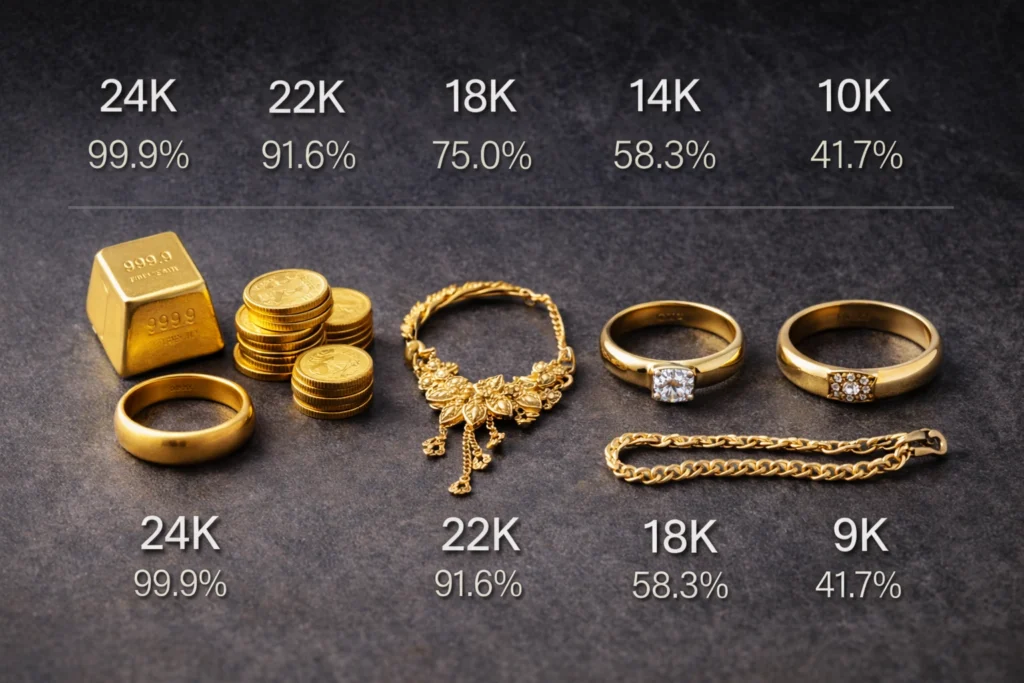
Gold purity is measured in karats. Understanding the level of purity helps interpret how to sell gold jewellery in Canada, as most jewellery items come in a variety of karats. Therefore, the higher karats in your jewellery item indicate high purity, showcasing high prices. Some of the most commonly designed gold items are in a variety of karats, containing the following percentages of gold content.
| Karats | Gold Content |
|---|---|
| 24K | 99.9% |
| 22K | 91.6% |
| 18K | 75.0% |
| 14K | 58.3% |
| 10K | 41.7% |
| 9K | 37.5% |
In the Canadian gold market, the standard measuring unit for gold items is grams, while gold coins and bars are weighed in troy ounces. A standard ounce is about 28.3 grams, while a Troy ounce equals approximately 31.1 grams.
Type of gold item
The type of your gold items affects their value in Canada. Here are some of the most common forms of gold that exist in the Canadian gold market for buying and selling.
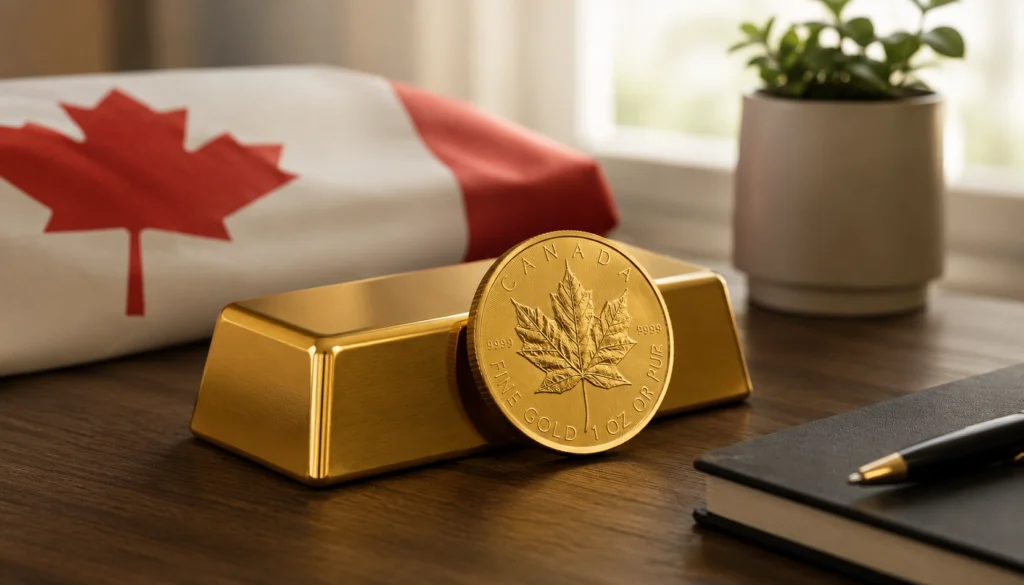
Gold bars and coins: These are often recognised as standardised products with known purity and weight. Gold coins and bars are typically investment-grade gold that sell closer to the spot price. Most commonly existing coins with competitive offers include Canadian Maple Leafs, American Eagles, and South African Krugerrands.
Gold Jewellery: The value of gold jewellery depends on its purity and weight. The high purity content of gold in the items boosts their price. Contrarily, broken jewellery or items with low purity cost less based on their melt value. For instance, branded jewellery such as Cartier, Tiffany, or Bulgari is sold at premium prices.
Scrap Gold: Scrap gold includes broken chains, mismatched earrings, damaged rings, and other unwanted items. These items are sold for their gold content. However, while selling scrap gold, you will get no premiums for artistry or design.
Gold-filled or gold-plated items: Gold-filled items contain a small amount of gold inside, while in gold-plated items, a very thin layer of gold exists. Both of these items are worth selling to buyers or jewellers because of their low value.
To calculate the value of your specific items in Canada, use the Gold Calculator, which provides up-to-date, precise results. You will get instant results based on your input with the highest accuracy.
How to Check Your Gold Value?
It is wise to check the current market value of your gold items before selling so that you get fair pricing for your items. Consider the following aspects to interpret the value of your gold in Canada.
Check purity, such as 18K, 22K, or 24K.
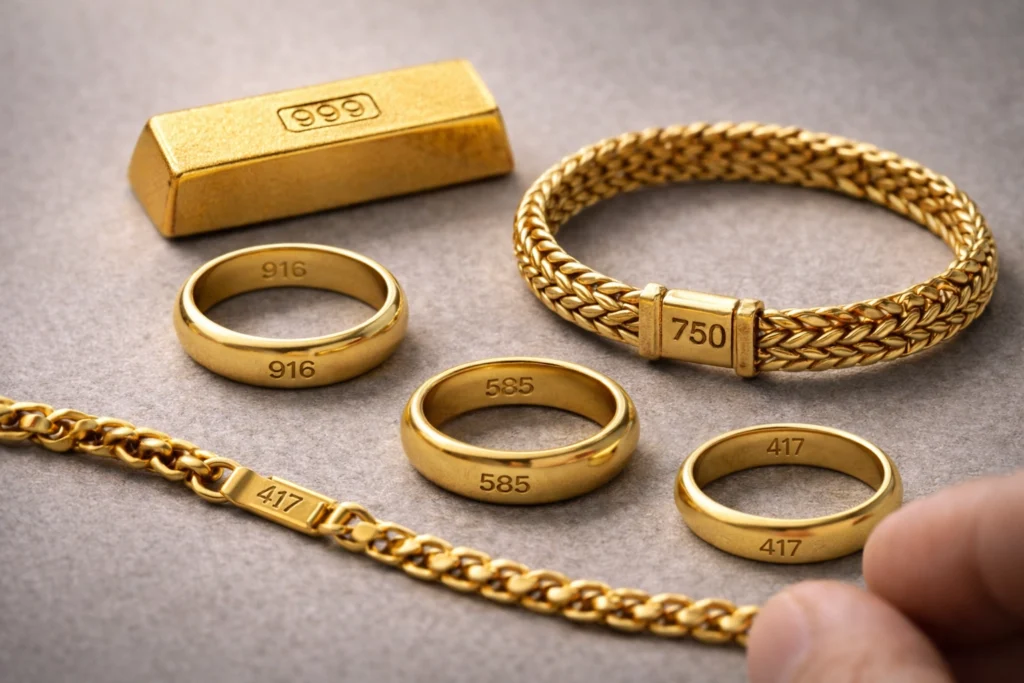
To check the purity of your gold items, carefully examine the hallmarks on them. These are the small stamps on gold that indicate the item’s purity, representing karat markings. Canadian jewellery features stamps indicating the percentage of gold purity in items such as the following:
| Hallmark | Karats | Percentage of Purity |
| 999 | 24K | 99.9% pure |
| 916 | 22K | 91.6% pure |
| 750 | 18K | 75.0% pure |
| 585 | 14K | 58.5% pure |
| 417 | 10K | 41.7% pure |
These hallmarks indicate the stated level of purity of gold. In case you don’t see a hallmark on your item or if it is worn, ask a reputable jeweller or your buyer to test its purity. Most jewellers or buyers do this test for free, especially if you are considering selling your items.
Weigh your gold using a digital scale.
Use a digital scale to weigh your gold item in grams. A scale accurate to 0.01 grams is ideally precise for smaller items, while a scale with 1 g accuracy is sufficient for large quantities. For accurate weighing of your items using a digital scale:
- Separate all your gold items by karats.
- Remove non-gold items like gemstones, clasps, and other components.
- Take at least 3 to 4 measurements for each group to ensure consistency.
- Keep a written record of the measurement of each purity group.
Compare the current market price per gram.
To check the value of your gold item, find the current market price of gold per gram for 24K. The value of your gold item will be indicated by a percentage of the price that you see for 24K based on your item’s purity. Comparing the spot price of gold per gram with your item’s helps you determine its estimated value in the market.
Calculate the estimated value before selling.
You can calculate the estimated value of your valuables manually or using a digital tool. This helps you ensure that you get an optimal price for your item, preventing you from potential losses. To manually calculate the estimated value of your items before selling:
- Determine the spot price for pure gold per gram.
- Multiply the determined price by your gold’s purity percentage.
- Multiply the obtained value by the weight of your item in grams.
- Obtain the total melt value.
Example Calculation
Suppose you have
- 15 grams of 14K gold
- 5 grams of 18K gold.
- The current spot price of gold is $90 CAD per gram.
14K gold value per gram = $90 x 0.583 = $52.47
Total for 14K = 15g x $52.47 = $787.05
18K gold value per gram = $90 x 0.75 = $67.50
Total for 18K = 5g x $67.50 = $337.50
Total melt value = $1,124.55
This estimated value is based on a theoretical calculation. Actual offers vary from estimated results. Also, these offers often come as 70% to 90% of melt value, depending on the buyer’s type and the purity of gold. For quick and more precise estimation, input the gold’s purity and weight into the Gold Calculator to get instant results.
Where Can You Sell Gold in Canada?
When considering how to sell gold in Canada, you may have several options, each with its own advantages and pitfalls. Understanding the different aspects of each option helps you align the most suitable options with your needs.
Common Selling Options
Here are some of the most common selling options for gold in Canada.
Local gold buyers
Most Canadian cities host local and specialised gold buyers at different locations. Local gold buyers in your city often offer competitive rates. However, different buyers may offer different prices based on their locations and reputations. Therefore, it is recommended to do comprehensive research about your items’ current valuation and test their purity before selling your gold.
Jewellery shops
Canada is rich in jewellery shops. Several independent jewellers buy gold, offering you fair prices. They are open to purchasing your jewellery items or scrap gold to melt it down to new pieces. You can physically visit these jewellery shops to get estimated prices for your gold or surf them online. Irrespective of the way you choose to sell your gold in Canada, make sure that your buyer holds a lasting reputation.
Pawn shops
Pawn shops are independent regulatory bodies that work across Canada and operate under provisional regulations. Pawn shops offer you loans against your valuable assets. Or some even buy your gold, releasing instant payments. It is recommended to sell or lend your items to pawn shops if you need small and instant amounts for your valuables.
Online gold buyers
In the past few decades, like other businesses, gold buyers have also gained popularity. You can search for online gold buyers in Canada and check their credibility by reviewing their ratings. They offer you competitive prices for your items that you can accept or decline based on your suitability. If you accept the offer, they release payment, and if you decline, they return your assets free of cost.
Private buyers
Private buyers often come as the most suitable option for you if you are selling high-value items such as gold coins, bars, or antiques. Where it seems a suitable option, selling your precious items to private buyers requires you to be extra cautious. You must cross-check the credibility, payment methods, and other terms & conditions of private buyers before closing a deal.
Step-by-Step Process to Sell Gold
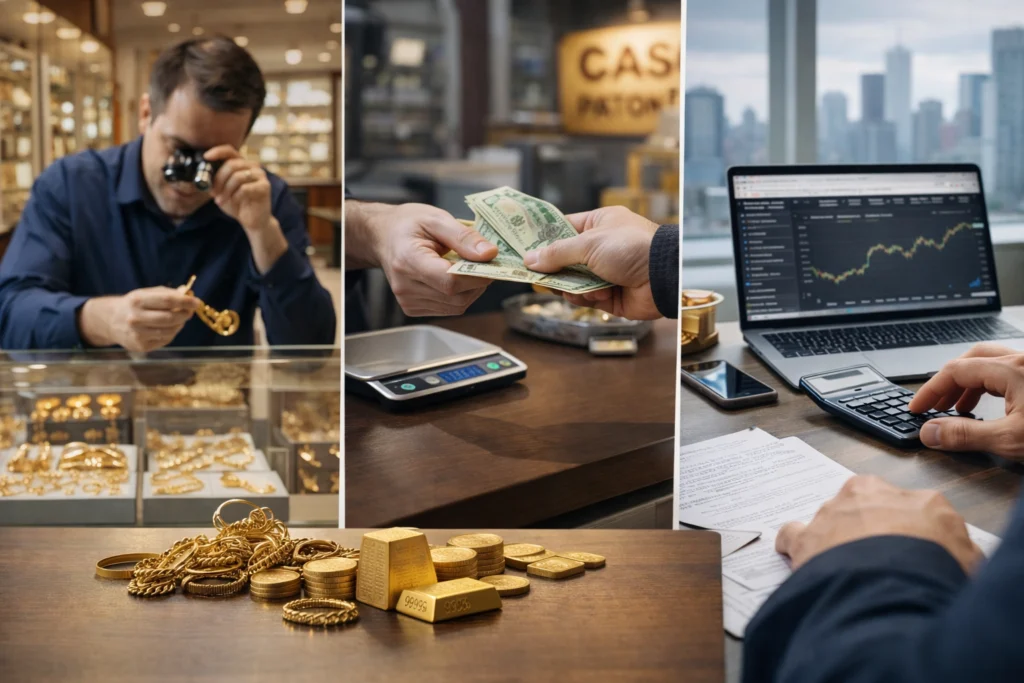
While selling your precious items, you must be aware and organise yourself. This makes the process smooth, helping you avoid mistakes. Here is a step-by-step guide for how to sell gold in Canada, ensuring a fair deal.
Step 1: Check the current gold price
Gold prices fluctuate constantly. Even your one-time search to check live gold prices may show different results across different websites with slight variations. Also, you will see different prices every day, or even the prices displayed in the morning may vary from those of the evening. It is advisable to calculate the price per gram of 24K gold, which serves as a benchmark.
Checking current gold prices helps you interpret whether it is a favourable time to instantly sell your gold or hold onto it and wait. However, it is crucial to track gold rates using credible sources. One of the most reliable tools to check current gold rates in Canada is the Gold Calculator, which displays current market prices based on real-time data assessment.
Step 2: Test purity if unsure
Gold items have specific hallmarks imprinted on them, denoting their level of purity. If your items do not carry these hallmarks or you suspect their purity, you may ask your jeweller for a purity test. Many jewellers or gold buyers perform this test free of cost, especially if you are considering selling your items to them, while others charge a fee based on their location and reputation. Common testing methods include:
Acid Test
The acid test is a widely used test to interpret the purity of gold. To perform this test, a small scratch is made on a gold surface where acids of different strengths are applied, which indicates the approximate karats.
Electronic Tester
Unlike the acid test, this method is non-destructive. It estimates the purity of gold items using the electrical conductivity method.
XRF Analyser
An X-ray fluorescence machine is expensive equipment that provides more precise readings using X-ray radiation to estimate the purity level of gold. However, it is only found at specialised dealers.
Step 3: Calculate expected value
Before contacting buyers, you must interpret the current market value of your gold assets. Calculating the expected value of your items helps you get a baseline for comparing different offers you receive from buyers. This ensures that you do not get underpaid.
To estimate your gold’s melt value, add your item’s determined weight and purity. The valuation you get from the estimated calculation may not exactly match the perceived offers; however, it provides you with an estimated value to close a fair deal with minimum losses.
Step 4: Visit multiple buyers
When you are searching for how to sell gold in Canada, you may get several online or physical selling options with multiple offers based on your intentions. Even in a hustle, you should never settle for the first offer you get. You must visit at least three to four buyers looking for both walk-in and online options.
Receiving offers from multiple buyers gives you insights to compare the offered prices with your estimated valuation. Take some time to review every offer and choose the most suitable offer. Also, it is recommended to review the different aspects of online and physical dealing, as each option has its own perks and pitfalls.
Step 5: Compare offers carefully
After gathering multiple offers, compare each of these carefully. It is wise to write down all the offers received and make a comprehensive comparison of these, considering the following aspects.
- Price per gram offered for each karat.
- Deductions for stones or non-gold components.
- Testing fee, handling fee, or any hidden charges.
- Payment method and timeline.
Ask each buyer about the narrated aspect. Then, calculate the final price you will receive at the end based on the provided answers. Choose to sell your assets where the profit margin is comparatively high.
Step 6: Negotiate for a better price
Instead of accepting or declining the offer instantly, politely ask if there is flexibility. Remember, even a small increase per gram may add significantly to the final price. For instance, an additional $2 per 50 grams of gold makes an extra $100 in your pocket.
In this regard, knowing the spot prices and the estimated market value of your items helps you negotiate the prices with optimal profit. Therefore, always try to negotiate with your buyer to get a better price for your gold items.
Step 7: Choose a secure payment method
Once you select the buyer to sell your gold, review their payment method thoroughly. Try to pursue the most reliable method to get paid. If you get payment in cash, count it at least twice in front of the buyer before leaving their premises. This helps you prevent a possible mishap.
Among all methods, bank transfer is considered the most credible payment option, especially when you are getting payment in bulk. Make sure that the buyer uses the bank transfer to a Canadian account. Despite this, check if your account is credited and ask the buyer for a payment receipt.
Tips to Get the Best Price
Follow these useful tips to get the best prices for your gold items, avoiding payment downturns.
Sell when prices are high.
Tracking the historical trends of price fluctuations of gold in recent times helps you determine the best time to sell your gold, maximising profit margin. Based on these estimations, interpret if prices are near highs; it is the best time to sell your valuables.
Avoid urgent selling decisions.
Financial pressure and a shortage of time restrict them from shopping around or negotiating. Therefore, try to plan your way as far as possible. If you foresee that in the near future you might need to sell your gold, go for early research.
Always get more than one quote.
Different places in the same region may affect prices. The jewellers living in prime locations often impose more deductions, decreasing the final payouts for your items. Therefore, always get more options and choose the most suitable offer.
Understand buyer deductions
When you visit a jeweller to sell your gold, ask them for additional charges that might be included in the final valuation. Common deductions at the buyer’s end may include testing, handling, and refining fees. Therefore, you must ask your buyers to close a transparent deal with no hidden charges.
Stay updated with daily prices.
Gold is a global asset, and its value changes constantly. It is possible that the price you estimated at the time when you planned to sell your assets decreases at the time when you are ready to hand them over to the buyer.
Common Mistakes to Avoid
When you are selling your gold items in Canada, you must be very cautious. Even the experienced dealers may skip crucial aspects, considering them unworthy. This may lead you to settle for less than the actual valuation of your valuables, resulting in unintended losses.
What Not to Do When Selling Gold?
Here are some of the most common mistakes buyers make while selling gold to avoid possible pitfalls.
Selling without checking the price
Skipping this aspect prevents you from judging whether the offered price for your items is fair or not. Therefore, you must track updated gold spot prices globally and calculate the current market value of your items using a reliable tool.
Accepting the first offer
Even in a hurry, never settle for the first offer you get for your gold assets. Visit at least three to four buyers using physical or online sources. Based on the estimated market price of your items, try to bargain to get a fair price.
Ignoring gold purity
The purity of gold significantly measures its valuation. Don’t forget to check the hallmark on your gold item to determine its purity before going to a jeweller to sell it. Also, you may ask a reputable jeweller to test it to determine its purity.
Not comparing buyers
When you visit multiple buyers, they offer different pricing models and margins. If you don’t get multiple offers from different buyers, you often have to settle for less than your item’s valuation.
Falling for unfair deals
Some practised jewellers target uninformed sellers offering low prices and hidden fees. Such unfair deals restrict you from getting the real valuation of your items.
Safety Tips When Selling Gold
While selling gold in Canada, you must be cautious so that you get the real valuation for your gold items. Here are some useful tips that will help you learn the safety considerations for selling your gold, ensuring fair dealing.
Meet buyers in secure locations.
While carrying your gold assets, make sure to meet buyers in secure locations. Always choose established business places, such as jewellery or pawn shops. If you choose to sell your gold online, confirm their credibility and ask them to meet in public locations.
Avoid carrying large amounts openly
If you are selling high-value assets or gold in large quantities, avoid displaying them publicly. Even if these are small jewellery assets, taking them with caution is recommended. Try to conceal the items in secure boxes or discreet bags.
Use trusted payment methods.
Make sure to use trusted payment methods. Bank transfer is considered a safer option than cash, especially for large amounts. If you are opting for cash payment, count it at least twice at the buyer’s premises and keep it with great care.
Keep transaction records
Whether you get paid via cash or bank transfer for your sold gold assets, take and keep the records of transactions with care. Saving copies of payment records prevents you from possible disputes that may arise in the future.
Verify buyer credibility
When you are selling your gold in Canada, you owe no liability to confirm the buyer’s credibility by checking their online reviews and ratings. Credible buyers are always transparent and execute their customers’ remarks without manipulation.
Quick Checklist Before Selling
When you feel that you have considered all the important steps and are ready to sell your gold in Canada, you must go through this quick checklist. Make sure that you have accompanied each step and mark a tick in front of it.
| Task | Completed |
| Checked your gold purity and weight for each item separately. | |
| Tracked and noted the up-to-date spot price of gold using a reliable calculator. | |
| Estimate the valuation of your gold items in CAD. | |
| Researched and compared at least three to four buyers. | |
| Verified buyer’s credibility through ratings and reviews. | |
| Confirmed payment method and timeline. | |
| Cleaned and carefully packaged your gold items. | |
| Considered all safety concerns. |
Final Thoughts
Learning how to sell gold in Canada helps you cash in your unused or safe-haven gold items securely. Whether you are selling gold coins, bars, jewellery items, or scrap gold, the process of selling your items remains the same. However, the valuation changes significantly based on the type of item.
The Canadian gold market offers diverse options to sell your gold across local and online forums. Based on the purity of your items and the location of the buyer, you may get different prices. Instead of settling for a single offer, comparing offers from different buyers helps you get a better valuation for your valuables.
FAQs
What documents are needed to sell gold in Canada?
In Canada, most legitimate gold buyers require identification to comply with anti-money laundering regulations. The essential documents needed to sell your gold locally or online include:
Valid driver’s licence.
Passport.
Provincial ID card.
Proof of address (if desired by some buyers).
Can I sell broken or old gold items?
Yes, you can sell broken or old gold items based on their purity and weight. Broken chains, unmatched earrings, damaged rings, or other unwanted gold items are sold as scrap gold. However, you will not get premium prices for such items. Your buyers will pay you for these items based on the pure gold content of these items.
How do buyers test gold purity?
Reputable jewellers and gold buyers use several methods to verify gold’s purity. Common tests for testing gold purity include:
Hallmark Inspection: checking official stamps indicating karats.
Acid Test: Acids of different strengths are applied to the scratched area of gold to determine karats.
X-ray fluorescence (XRF) analyser: Reads gold purity using X-ray radiation.
Electronic Tester: Measures conductivity to estimate purity.
Is it better to sell gold as jewellery or for its melt value?
Well, it depends on your items’ condition. If you are selling designer jewellery, antique pieces, or items with craftsmanship, they fetch more as jewellery. However, common jewellery items, broken chains, damaged rings, or unmatched earrings typically sell best for their melt value.
How quickly can I receive payment after selling gold?
If you are selling your gold to a local buyer in Canada, they release payments instantly via cash or bank transfer in CAD. In the case of online selling, transactions may take from 1 to 3 business days following a bank transfer.
Are gold prices the same across all buyers?
No, although all buyers reference the same global spot prices, the prices fluctuate across different buyers based on their business model, overhead costs, and profit margins. A difference of about 5-10% between buyers is common.