We know how gold has been trading near record highs through 2026, and this has made more Canadians than ever ask the same practical question: How can I buy gold in Canada without overpaying, getting scammed, or running into a tax surprise later?
Well, the good news is that buying gold in Canada is way easier than most people expect. You can walk into a big-five bank branch, order online from a Royal Canadian Mint–authorized dealer, buy fractional grams through a fintech app, or add gold exposure through an ETF inside a TFSA. All of this is possible without handling a bar yourself (if you choose not to).
So, we’re here with a very helpful guide that will walk you through every practical way to buy gold in Canada. You’ll learn where to buy, how to compare prices, whether gold belongs in your RRSP or TFSA, what the CRA expects at tax time, and how to avoid the mistakes that trip up first-time buyers.
Table of Contents
Key Takeaways
- Purity matters “A LOT”: Physical gold that’s at least 99.5% pure is exempt from GST/HST in Canada. However, the same is not the case with jewellery.
- Multiple channels exist: You can buy from big banks (BMO, RBC, CIBC, TD), online bullion dealers, local coin shops, or fractional/digital gold apps.
- Registered accounts are possible: Eligible gold and silver bullion, coins,s and ETFs can be held in a TFSA or RRSP. However, that should be only through an approved trustee.
- Selling gold is taxable: Profits are treated as capital gains, with only 50% of the gain included in your taxable income.
- Large cash purchases are reported: Dealers must verify your ID and report cash transactions of $10,000 or more to FINTRAC.
- Buy from accredited sources: The Royal Canadian Mint and LBMA-accredited refiners guarantee purity, hallmarking and resale value.
What Should You Know Before Buying Gold in Canada?
We know you’re interested in buying gold but there are a few important considerations that are extremely important.
- Why are you buying gold? Investment-grade bullion (coins, bars and rounds at 99.5%+ purity) is bought for its metal content and price appreciation. On the other hand, jewellery and collectible coins carry design or numismatic premiums that rarely track the gold price. We recommend setting a budget that actually fits your overall portfolio. According to experts out there, gold should sit at roughly 5 to 10 percent of a diversified portfolio (and NOT the whole thing).
- There’s no legal cap on how much gold you can buy in Canada as an individual. However, the only trigger is procedural. What this means is that dealers must verify your identity and file a report with FINTRAC once a cash transaction reaches $10,000. Paying by e-transfer, wire,e or card doesn’t change how much you’re allowed to buy, only how the transaction is recorded.
- And last but not least, treat gold as a multi-year holding. Short-term price swings are common, and dealer premiums mean you generally need some price appreciation just to break even on a quick resale.

Why Do Canadians Buy Gold?
We often answer this question by asking a counter question: Why not? After all, gold is a long-recognised hedge against inflation and currency depreciation. It tends to hold value when stocks and bonds fall together. And it carries no counterparty risk (meaning nobody else’s default can wipe it out).
And if you don’t want to consider our opinion, the World Gold Council has actually tracked gold’s role as a strategic portfolio asset for decades. Which makes sense since gold’s demand has stayed strong through periods of high inflation, rate uncertainty, and geopolitical tension.
What Are the Main Ways to Buy Gold in Canada?
It is very important to understand that there’s no one “right” way to buy gold. This is because the best format depends on whether you want to hold something physical, keep it inside a registered account, or simply track the price without ever touching a bar.
Physical Gold Bullion
Physical bullion refers to coins, bars, and rounds of gold you can hold in your hand. Most Canadian buyers start here because it’s the most tangible and widely understood option.
Gold Coins
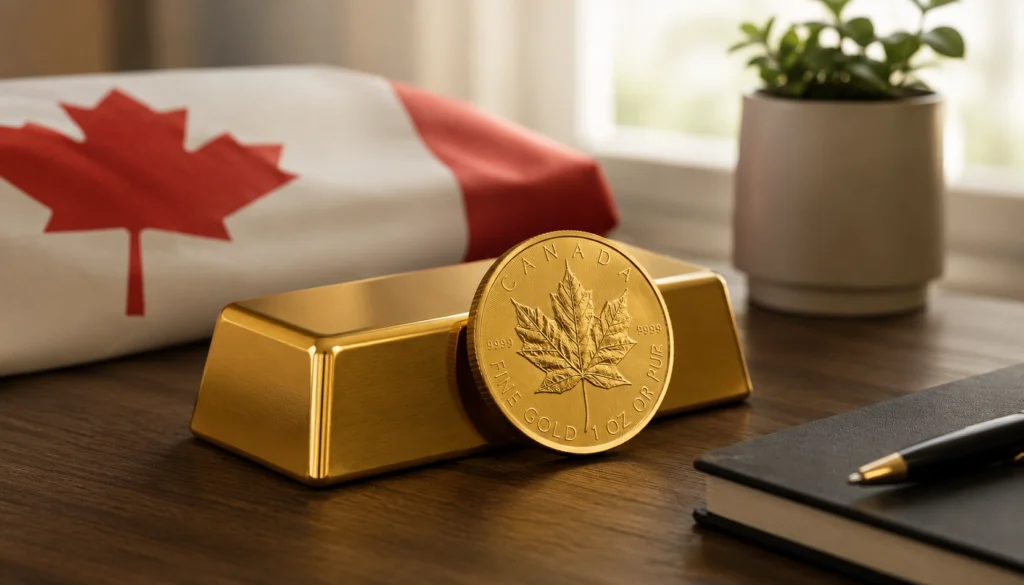
Government-minted coins, like the Royal Canadian Mint Gold Maple Leaf (99.99% pure), are legal tender, individually recognizable, and easy to resell almost anywhere in the world. Smaller coin sizes (1/10 oz, 1/4 oz) also make it easier to buy gold in smaller, more flexible increments.
Gold Bars
Bars and wafers, typically ranging from 1 gram to 1 kilogram, usually carry a lower premium per gram than coins once you move above a few grams. This actually makes gold bars cost-efficient for larger purchases. Look for bars produced by a refiner on the LBMA Good Delivery List, which sets the global standard for purity, hallmarking and traceability.
Gold ETFs and Funds
Exchange-traded funds such as gold-bullion ETFs trade on the TSX just like stocks and are backed by allocated physical gold. They can be bought inside a TFSA or RRSP through any discount brokerage.
Gold Mining Stocks
Ah yes, you can actually buy shares in gold mining or royalty companies. This gives you leveraged exposure to the gold price. Profits and losses can move faster than the metal itself since they’re tied to company operations, costs, and reserves as well as gold prices. Mining stocks can pay dividends and qualify for standard capital gains treatment, but they carry company-specific risk that bullion doesn’t.
How to Buy Physical Gold in Canada?
- Decide your budget and purpose. This includes everything like long-term holding, portfolio insurance, or a registered-account investment.
- Choose your product. Coins are for flexibility and recognisability. Bars are for lower premiums at larger sizes.
- Pick a reputable, licensed dealer. Look for Royal Canadian Mint authorization, LBMA-sourced bars, BBB accreditation, and verifiable reviews.
- Compare the dealer’s price against the live spot price so you know exactly what premium you’re paying.
- Complete identity verification if required.
- Choose delivery, in-store pickup, or dealer-partnered vault storage.
- Keep the invoice and any assay certificate. It is very important as you’ll need them for insurance, resale,e and adjusted cost base (ACB) tracking at tax time.
- Arrange secure storage before your gold arrives, not after.
Where Can You Buy Gold in Canada?
Canadians can buy gold through four main channels. Now each of them comes with a different trade-off between price, convenience, and control.
Online Gold Dealers
The Royal Canadian Mint’s online store and several independent Canadian bullion dealers sell coins and bars with nationwide, insured shipping. Online dealers typically offer the widest selection and the most transparent, spot-linked pricing. However, it would be best to confirm their buyback policy and review history before ordering.
Local Bullion Dealers
Brick-and-mortar coin and bullion shops let you inspect a piece before paying and walk out with it the same day. Selection is usually narrower than online and sometimes premiums can run slightly higher.
Banks and Financial Institutions
Among Canada’s Big Five banks, BMO, RBC and CIBC still sell physical gold and silver bullion, either in-branch or online, and TD runs its own TD Precious Metals storefront. Buying from a bank offers familiarity and trust, though premiums tend to run higher than specialist dealers.
Private Sellers and Marketplaces
Classified sites, estate sales, and private collectors can offer lower prices, but there is a big catch. They come with meaningfully higher risk: no purity guarantee, no receipt trail, and no recourse if the item turns out to be fake or underweight. Still, if you opt for this method, it would be best to meet in public and verify the hallmark and weight yourself. The recommended course would be a quick professional test before paying.
Online vs Local Gold Dealers
| Factor | Online Dealers | Local Dealers |
| Product Selection | Wide national catalogue across coins, bars, sizes and mints. Much easier to compare side by side. | Limited to in-store stock; less common products may need to be special-ordered. |
| Pricing | Often lower premiums thanks to lower overhead, with pricing tied directly to the live spot rate. | Premiums can run higher, though some shops offer a discount for cash payment. |
| Delivery | Insured shipping (typically a few business days), or optional vault storage instead of delivery. | Immediate in-person possession. Means no shipping wait and no transit risk. |
| Personal Inspection | Not possible before checkout; you’re relying on the dealer’s reputation, photos, and return policy. | You can weigh, measure and inspect the hallmark before you pay. |
| Payment Options | E-transfer, wire, and card (often with a surcharge); some now accept digital wallets. | Cash, debit and sometimes cheque; cash payments of $10,000 or more trigger FINTRAC reporting. |
| Buyback Services | Many dealers buy back what they sell and provide prepaid, insured return shipping. | Instant in-person buyback and same-day cash. This can be very useful if you need liquidity quickly. |
How to Compare Gold Prices in Canada?
It is crucial to understand that the price you’re quoted at checkout is made up of four separate components. And understanding each one is very important in telling a fair price from an inflated one.
- Gold Spot Price
The spot price is the live, global wholesale price for one troy ounce of gold, quoted continuously as XAU/CAD. You can track it in real time through resources like TD Precious Metals’ live gold chart, and use a tool like a gold calculator.
- Dealer Premium
The premium is actually the markup a dealer adds over spot to cover minting, distribution,n and their margin. It typically runs 2 to 8% and varies by product. That said, smaller coins and popular brand names usually carry higher premiums.
- Shipping and Insurance Costs
Most online dealers charge for insured courier shipping unless your order clears a free-shipping threshold. That said, always (and we mean always) confirm the shipment is fully insured for its declared value in transit, not just up to a standard courier limit.
- Buyback Spread
The buyback spread is the gap between what a dealer will pay you to sell back and what they charge to buy. A tighter spread means less of your money is lost simply moving in and out of the position. That’s why it is important to ask about it before you buy, not when you’re ready to sell.

Can You Buy Gold Through an RRSP or TFSA?
Yes. But it is not as straightforward as it seems. You can buy only bullion that meets strict conditions. Like under the CRA’s Income Tax Folio S3-F10-C1 on qualified investments, gold must be at least 99.5% pure (99.9% for silver), produced by the Royal Canadian Mint or an LBMA-accredited refiner, and bear a hallmark identifying the refiner, purity and weight. Critically, an approved trustee or custodian must hold the bullion. The Royal Canadian Mint confirms that gold stored at home never qualifies for registered-account treatment, no matter how pure it is.
For most investors, a Canadian-listed gold ETF is the simpler route: it’s unambiguously eligible, trades through any self-directed brokerage, and avoids the custodial paperwork physical bullion requires. Either way, gains grow completely tax-free inside a TFSA and tax-deferred inside an RRSP until withdrawal.
Is Buying Gold Taxable in Canada?
Well, it depends a lot on what you’re buying and when. At the point of purchase, investment-grade gold bullion at 99.5% purity or higher is classified as a financial instrument under the Excise Tax Act and is exempt from GST/HST. However, gold jewellery (regardless of karat) does not qualify and is taxed like any other retail good.
At the point of sale, it’s a different story. The CRA treats bullion as capital property, so any profit is a capital gain, and only 50% of that gain is included in your taxable income. There’s no minimum threshold that exempts small gains from being reported.
Separately, dealers are required under Canada’s anti-money-laundering rules to verify your identity and file a Large Cash Transaction Report with FINTRAC for any cash payment of $10,000 or more.
How to Check Whether Gold Is Genuine?
- Hallmark check. Genuine bars and coins are stamped with the refiner’s mark, purity, and weight. Also, it is vital to confirm if the refiner appears on the LBMA’s accredited refiner list.
- Weight and dimensions. Compare the item against the refiner’s official published specifications. This is where even small deviations can indicate a fake or a hollowed-out piece.
- Sealed assay packaging. Many bars ship in tamper-evident packaging with a matching serial number and assay card. It would be best not to break the seal if you plan to resell later.
- Professional testing. When it comes to larger purchases, a jeweller or dealer can run a quick, non-destructive XRF (X-ray fluorescence) test to confirm purity.
- Price sanity check. This is something that should be the golden rule. An offer priced well below the current spot price is one of the clearest warning signs of a counterfeit or scam.
How Should You Store Gold Safely?
How you store gold affects both its security and, if it’s inside a registered account, whether it stays compliant with CRA rules.
- Home safe. This is a convenient and private option, but check with your home insurer first. It’s because standard policies often cap coverage for precious metals far below their value unless you add a rider.
- Bank safety deposit box. Physically secure, but contents typically aren’t automatically insured by the bank.
- Third-party insured vault. Many bullion dealers partner with professional, fully insured depositories, giving you audited storage without keeping gold at home.
- Registered-account custody. Gold held inside a TFSA or RRSP must sit with a CRA-approved trustee or custodian. This means that self-storage automatically disqualifies it from registered-account treatment.
Common Mistakes to Avoid When Buying Gold
- Buying gold jewellery expecting it to have bullion-level purity or to qualify for the GST/HST exemption.
- Focusing only on the spot price and ignoring the dealer premium you’re actually paying.
- Skipping due diligence on a dealer’s accreditation, reviews, and Better Business Bureau record.
- Paying in untraceable cash without insisting on a proper receipt or invoice.
- Storing gold at home without confirming your insurance policy actually covers it.
- Trying to time short-term price swings instead of treating gold as a multi-year hedge.
- Not asking about buyback terms and spreads until it’s already time to sell.
- Forgetting to track adjusted cost base and report capital gains when gold is eventually sold.
Quick Checklist Before You Buy Gold
Set a clear budget and decide what share of your portfolio gold should represent.
Choose coins, bars, ETFs or digital gold based on liquidity and storage needs.
Confirm the dealer is Royal Canadian Mint–authorized or sources from LBMA-accredited refiners.
Check today’s live spot price and calculate a fair price before you buy.
Ask about the buyback spread and return policy up front.
Decide on storage (home safe, safety deposit box, or insured vault) before the gold arrives.
Keep every receipt and assay certificate for insurance and tax purposes.
If buying inside an RRSP or TFSA, confirm the product and custodian are CRA-eligible first.
Final Thoughts
Buying gold in Canada isn’t complicated once you know the landscape. Banks, online dealers, local shops and digital platforms all offer legitimate ways in, and CRA rules around GST/HST, capital gains and registered accounts are well documented and easy to follow with a bit of planning. Before you commit to a purchase, run today’s numbers through a tool like a gold calculator so you know exactly what a fair price looks like for the weight and purity you’re buying.
FAQs
What is the minimum amount of gold I can buy in Canada?
Well, there’s no legal minimum. Fractional coins start around 1/20 oz, and digital gold platforms let you buy as little as a few dollars’ worth.
Is it better to buy gold coins or gold bars?
Both have their sets of conveniences. Coins are easier to sell in small increments. They are also individually recognizable worldwide. Gold bars, on the other hand, typically carry a lower premium per gram once you’re buying more than a few grams.
Can I buy gold directly from a Canadian bank?
Of course, you can. BMO, RBC and CIBC all sell physical gold bullion in-branch or online, and TD runs its own precious metals storefront
Do I need identification to buy gold in Canada?
Well, it is not needed in most cases for smaller purchases. However, any cash transaction of $10,000 or more requires the dealer to verify your identity and file a report with FINTRAC under Canada’s anti-money-laundering rules.
Can I sell gold back to the same dealer?
Many dealers, especially ones affiliated with the Royal Canadian Mint, will buy back what they sold you. They can sometimes do it with prepaid, insured return shipping. However, it would be best to ask the buyback spread beforehand.
Is buying gold online safe in Canada?
Yes,s it is 100% safe as long as you use a reputable, established dealer with insured shipping and verifiable reviews.
How long should I keep gold as an investment?
Most industry advisors treat gold as a multi-year holding. Not a short-term trade. It makes sense since dealer premiums and price volatility mean quick flips rarely pay off with short-term trades.
Can I take physical gold out of my RRSP?
Yes, but withdrawing physical gold from an RRSP is treated as a deemed disposition at fair market value. This means it’s added to your taxable income for the year. It is highly recommended to talk with your account custodian and a tax professional before requesting an in-kind withdrawal.