Gold is strangely beautiful because it doesn’t come with a price tag the way most things do. Like your ring, a gold coin, or a stack of scrap jewellery in a drawer, is worth whatever the market says gold is worth at that exact moment (along with factors like purity and the weight). In short, there are three pieces of the puzzle: spot price, purity, and weight.
And once you understand how these three pieces fit together, you can work out a fair estimate for almost anything gold. There is also a faster route where you can skip the manual math entirely and use a gold calculator that pulls live spot pricing automatically.
Key Takeaways
- Three inputs are crucial whenever you want to calculate the gold price in Canada. The live spot price, the item’s purity (karat), and its weight in grams.
- Karat isn’t a nice-to-have detail. It’s actually the multiplier. A 10K item and a 24K item of identical weight can differ in value by more than half.
- Spot price is quoted per troy ounce, not per gram.
- Gemstones, clasps, and solder don’t count. Only the actual gold content is priced.
- The number you calculate is a starting estimate, not a guaranteed payout.
Table of Contents
What Determines the Price of Gold in Canada?
It’s very important to understand that gold trades on a single global market, which means that Canadian gold pricing isn’t set independently. In fact, it moves off the same international benchmarks everyone else uses and then gets translated into Canadian dollars.
Here are four things that go on to shape the price of gold in Canada.
- The global spot price. Gold is bought and sold continuously on international markets. That trading activity then goes on to set a live benchmark price (which is most commonly displayed in US dollars per troy ounce).
- The USD/CAD exchange rate. Remember that the benchmark price is set in U.S. dollars. What this means is that every quote in Canadian dollars is actually two numbers multiplied together. These are the USD gold price and the current exchange rate. And the loonie weakening against the dollar is going to increase Canadian gold prices and vice versa. By the way, you can track the live rate through the Bank of Canada’s daily exchange rate page.
- Purity. Ah, this is very important. See, pure 24-karat gold trades at the full spot price per gram. And when there is anything less than 24K, it is an alloy (mixed with metals like copper, silver, or zinc). In other words, only the gold fraction of the item’s weight actually carries value.
- Supply, demand, and macroeconomic sentiment. No surprises here. Inflation expectations, interest rate decisions, currency strength, and geopolitical uncertainty all push and pull on gold demand day to day. This is why the spot price moves constantly rather than sitting still.
How Is Gold Price Measured in Canada?
Simply put, the price of gold globally is measured in troy ounces. This is an older unit of measure still used across the precious metal trade. One troy ounce works out to roughly 31.10 grams. Also, it is a bit heavier than your “regular” avoirdupois ounce that is used for everyday weighing.
Canadian retail and jewellery pricing, on the other hand, is almost always quoted per gram. It’s because rings, chains, and small coins weigh only a few grams. That means before you can price anything domestically, the ounce-based spot quote has to be converted down to a gram-based figure.
Some dealers, particularly those serving South Asian and Middle Eastern communities, also quote in tola (roughly 11.66 grams) or tael. Therefore, it would be worth checking which unit a quote is actually using before comparing two offers.
How to Calculate Gold Price in Canada?
To make it easier for you, we’ve divided the process into six easy steps.
Step 1: Check the Current Gold Spot Price
Start with the live 24K spot price in Canadian dollars per gram. It is very important since this number changes throughout the trading day. Best would be pulling it fresh right before you calculate. Reliable, frequently updated sources include the Royal Canadian Mint’s bullion pricing and financial data sites.
Step 2: Confirm the Gold Purity
Next up, you’ll have to look for a hallmark or stamp on the item. Something like “10K,” “14K,” “18K,” “.750,” or “.999.” This stamp is very important since it tells you the ratio of pure gold to alloy metal, which is the single biggest factor separating a high-value piece from a low-value one at the same weight. Also, if a visible stamp is not there, we highly (highly) recommend professional testing.
Step 3: Weigh the Gold Accurately
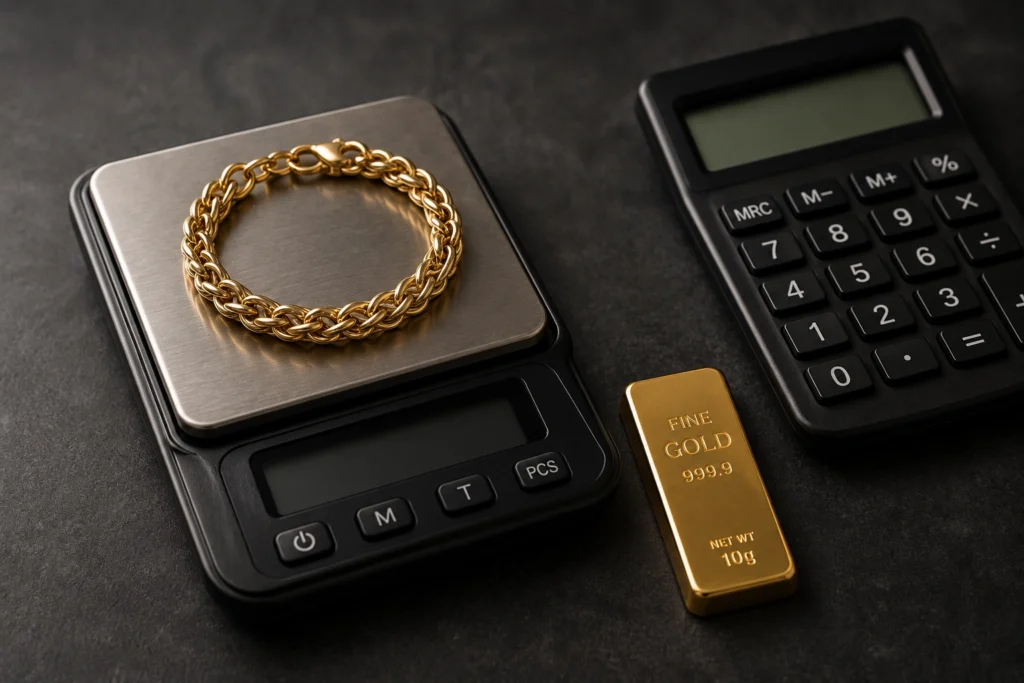
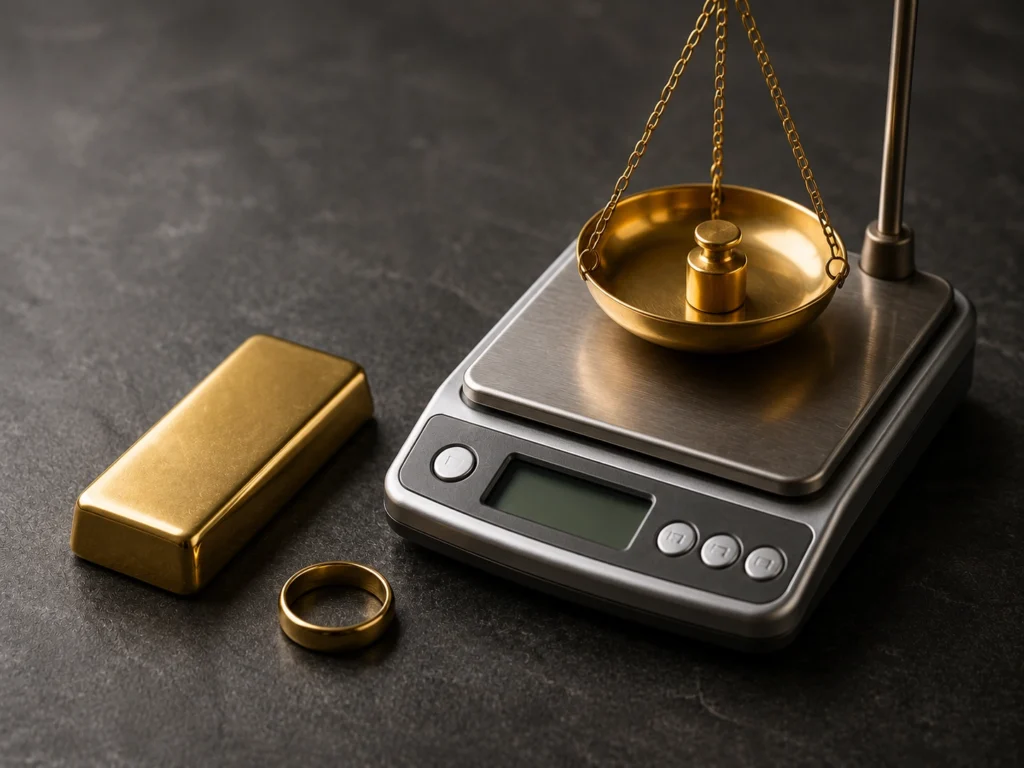
Many people make the big mistake of underestimating this step. Always (we mean always) use a jewellery-grade digital scale, ideally one that measures to at least one-tenth of a gram. Kitchen scales and postal scales usually aren’t precise enough for small items. They can also throw your final estimate off by a noticeable margin.
Step 4: Convert the Weight into Grams
If your scale gives a reading in something other than grams, convert it first, since grams are what the spot price and the rest of the formula use. A troy ounce is about 31.10 grams. A regular (avoirdupois) ounce, the kind used for everyday items, is about 28.35 grams. These two aren’t the same, so check which “ounce” you’re working with before doing the math.
Step 5: Apply the Gold Purity Percentage
Now take the karat purity percentage and multiply it against the item’s total weight. This isolates the amount of actual gold inside the piece, stripping out the alloy metals that don’t carry gold value.
Step 6: Calculate the Estimated Gold Value
This is very easy. To do it, you’ll have to multiply the pure gold weight from Step 5 by the current spot price per gram from Step 1. The result is your baseline estimated value, before any dealer premium, buyback spread, or craftsmanship adjustment is applied.
Gold Price Calculation Formula
Gold Value = Weight (grams) × Purity (%) × Spot Price per Gram (CAD)
Consider this example explaining the formula. Say the current 24K spot price is C$196 per gram, and you’re pricing a 14K bracelet that weighs 12 grams.
- Purity of 14K gold = 58.5%
- Pure gold content = 12 g × 0.585 = 7.02 g
- Estimated value = 7.02 g × C$196 = roughly C$1,376
That figure represents the raw gold content only. A dealer’s actual offer will typically sit below this, since they need to cover refining costs and their own margin, while a retail jewellery price might sit above it, since it also bakes in design and craftsmanship.
That said, a gold calculator Canada is a much better and more reliable option since it gets you there instantly without doing the multiplication by hand.
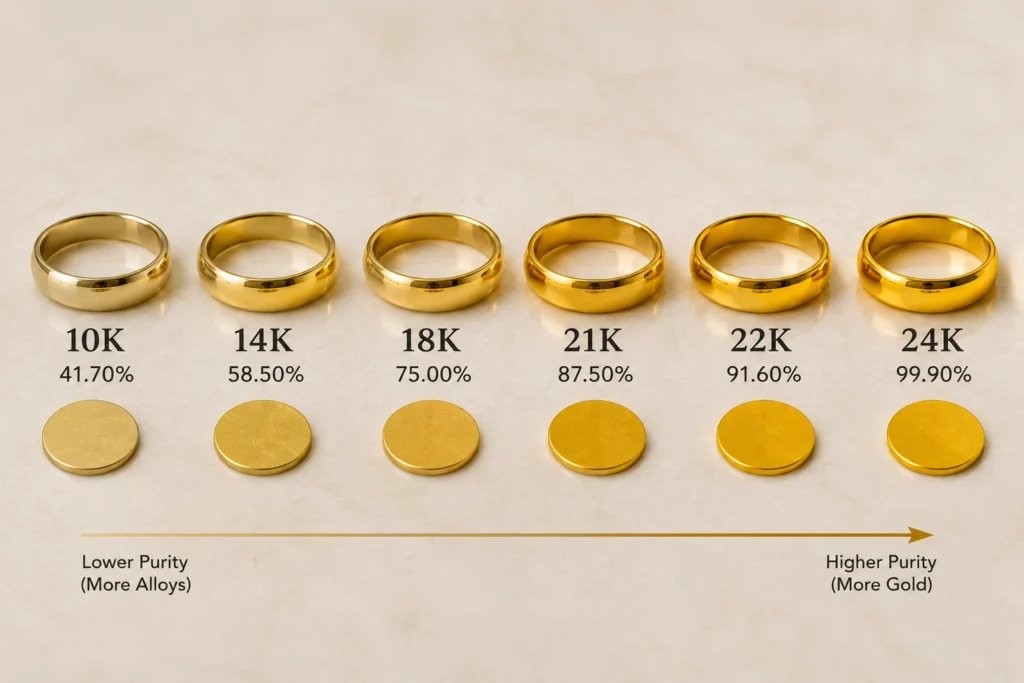
Gold Purity and Karat Conversion Table
| Gold Karat | Gold Purity |
| 10K | 41.70% |
| 14K | 58.50% |
| 18K | 75.00% |
| 21K | 87.50% |
| 22K | 91.60% |
| 24K | 99.90% |
Please remember that 24K is treated as “pure” gold for pricing purposes even though it technically measures 99.9% rather than a flat 100%.
How to Calculate the Value of Gold Jewellery?
Given that jewellery is rarely 100% pure gold by weight, there are a few more checkpoints to consider.
- Check the Hallmark or Karat Stamp. Most Canadian and internationally sourced jewellery carries a small stamped mark somewhere discreet, inside a ring band, on a clasp, or on the back of a pendant, indicating karat or millesimal fineness (like “.585” for 14K).
- Remove the Weight of Stones and Other Materials: Diamonds, gemstones, pearls, enamel inlays, and even some clasps and findings add weight to a piece without adding gold value. A jeweller will typically weigh these separately (or estimate their weight using standard stone-weight charts) and subtract that figure from the item’s total weight before applying the purity percentage.
- Consider Craftsmanship and Brand Value.e This is where jewellery pricing diverges from pure bullion pricing. A named designer piece, a vintage or antique item, or simply well-executed handwork can carry a premium well above its raw melt value; a buyer or appraiser may value the piece for what it is, not just what it weighs. On the flip side, if you’re selling to a refiner or a scrap gold buyer rather than a jewellery retailer, none of that craftsmanship premium usually applies. You’re paid for gold content only, at or below the calculated melt value.
Common Mistakes to Avoid When Calculating Gold Price
- Using the per-ounce spot price directly on a per-gram item. Do it after converting units. Not doing so will throw the whole calculation off by a factor of roughly 31.
- Assuming a “gold” stamp means 24k purity.
- Forgetting to subtract the weight of gemstones, pearls, or other non-gold materials before applying the purity percentage.
- Comparing quotes given in different units (grams versus tola, or troy ounces versus regular ounces) as if they were the same number.
- Using a stale spot price from earlier in the day or from a different currency without checking the current CAD conversion.
- Treating the calculated value as the guaranteed offer a buyer will pay, rather than as a fair-value estimate before margin.
Final Thoughts
It is clear by now that the math behind gold pricing isn’t complicated once it’s broken into its three moving parts. 1) How much the metal itself weighs. 2) How pure it is. 3) What the market is paying for it right now. Interestingly, where people usually go wrong isn’t the arithmetic. Instead, it’s skipping a step, like forgetting to subtract stone weight or mixing up units of measurement. Work through the six steps above in order, double-check your purity stamp, and you’ll land on a number that’s close to what any reputable dealer or jeweller would quote you.
FAQs
Does the gold price change every day in Canada?
Oh absolutely yes. Gold trades continuously on global markets during active trading hours, so the Canadian-dollar price can shift several times within a single day, not just once every 24 hours.
Is gold priced in Canadian or US dollars?
Well, the global benchmark is set in U.S. dollars per troy ounce. And then Canadian retailers and dealers convert it into CAD using the current exchange rate.
How can I calculate the price of 10K gold?
It is very simple. All you have to do is multiply the item’s weight in grams by 0.417 (the purity o10 K0k gold) and then multiply that result by the current spot price per gram in CAD.
How can I calculate the price of 14K gold?
You’ll have to multiply the item’s weight in grams by 0.585 (the purity of 14K gold), then multiply that result by the current spot price per gram in CAD.
Is the value of gold jewellery based only on weight?
No. Instead, there are factors like the weight and purity that set the baseline melt value. That said, sometimes the brand’s reputation and craftsmanship can also add more value to gold jewellery.
Why do different gold buyers offer different prices?
Well, each buyer applies their own margin on top of (or below) the calculated melt value. It usually depends on their overhead, resale channel, and how quickly they need to move inventory. That’s why it’s worth getting more than one quote before selling.
Do gold coins have a higher value than scrap gold?
Often, yes. This is because recognized bullion coins can carry a premium over their raw melt value because of their liquidity, authenticity, and collectability.
Can I calculate gold value without professional testing?
You can get a reasonable estimate using a visible karat stamp, an accurate scale, and the current spot price. However, if there’s no stamp, or you suspect the item might be gold-plated rather than solid, we highly recommend you consider professional testing.
Why the selling price may be lower than the market price?
You see, the spot price reflects the wholesale, no-margin value of raw gold. What this means is that a buyer offering to purchase your item needs to cover refining costs, business overhead, and their own profit margin. That’s why their actual offer will typically land below the calculated market value, sometimes significantly so depending on the buyer.