Having a drawer full of old sterling flatware or a handful of silver coins can make you ask a question: “How to calculate silver price in Canada?” Well, as it is the case with gold, calculating silver pricein 2026 is different. It is because the spot price is lower per ounce, purity marks vary more widely, and the gap between what your item is worth in raw metal and what a dealer will actually offer feels less obvious.
That’s why this guide is very important. It covers exactly how to calculate silver price per gram or per ounce in Canada, using nothing more than a kitchen scale, a purity stamp, and a live spot price. We’ll walk through the formula, run it against real numbers, and explain why the figure you calculate yourself and the figure a dealer quotes you are rarely identical.
Key Takeaways
- Remember that three inputs drive every silver calculation: weight, purity, and the live CAD spot price.
- Spot price, melt value, retail price, and buyback price are four distinct numbers. However, the single biggest mistake people make is that they treat these four numbers as interchangeable.
- Silver is priced by the troy ounce (31.1035 grams), not the everyday ounce most kitchen scales default to.
- Dealer spreads and premiums sit on top of your calculated melt value, so your own math gives you a benchmark, not a final offer.
- Silver price predictions 2026 vary enormously between banks and analysts, so treat any single forecast as one opinion among many, not a fixed target.
Table of Contents
What Does “Silver Price” Mean?
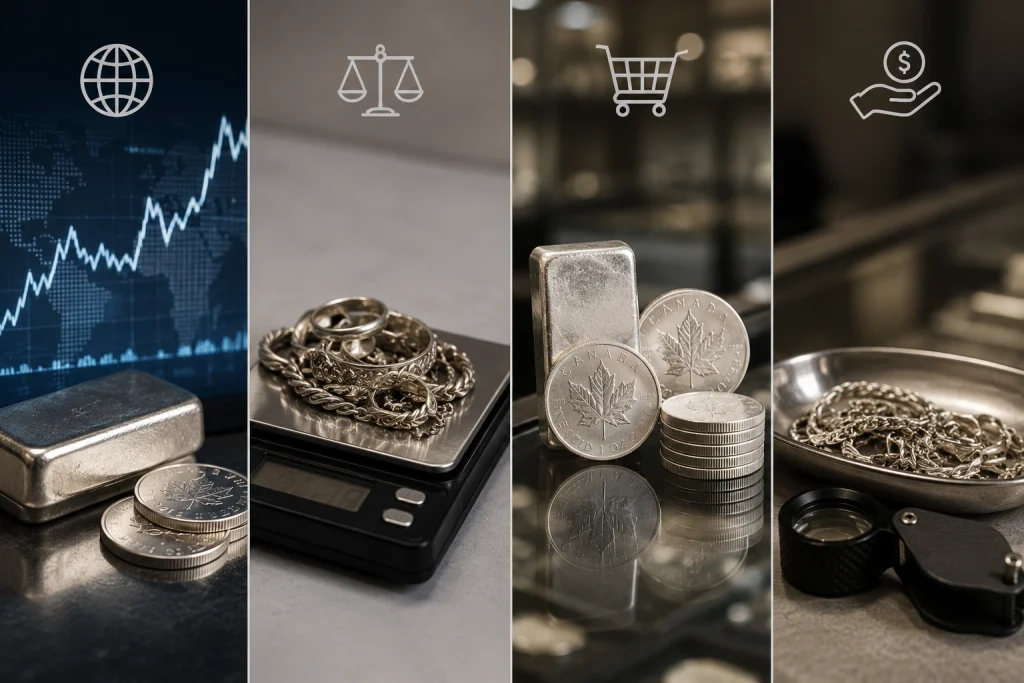
Now we understand how easy it is to think that “the silver price” is a single number. However, four different figures get lumped under that phrase. And the first thing you need to do is never get them mixed up.
| Price Type | Plain-Language Meaning | Why It Differs |
| Spot price | The live global market price for one troy ounce of raw. This is unrefined silver | Reflects pure metal only, before any refining, minting, or dealer costs |
| Melt value | What the actual silver content in your specific item is worth right now | Scaled down from spot price based on your item’s purity |
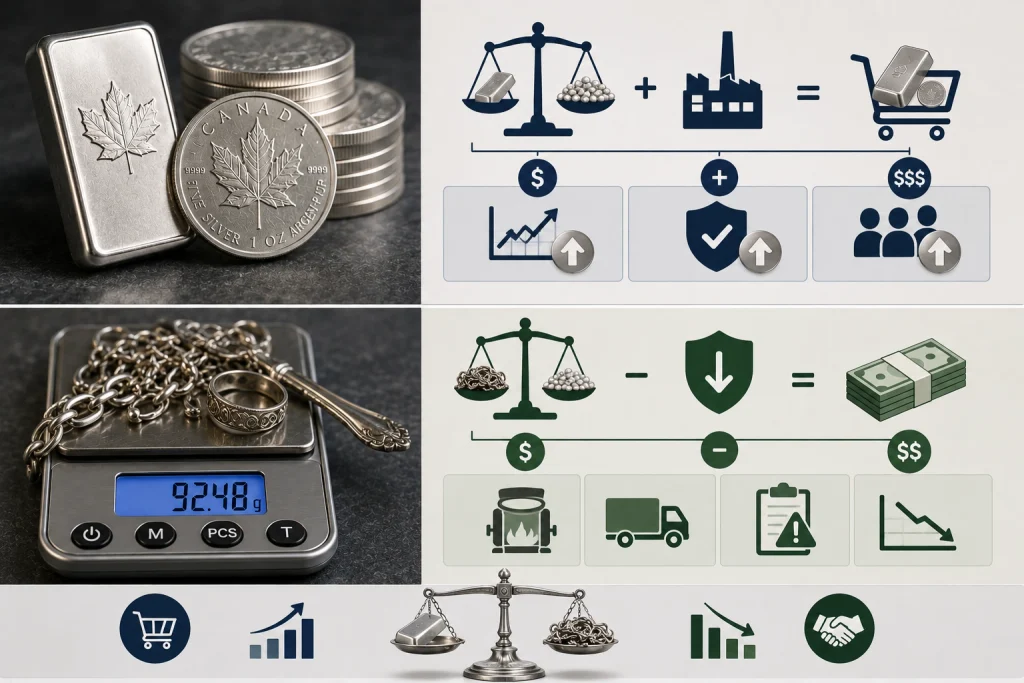
| Retail price | What a dealer charges you to buy silver coins, bars, or jewellery | Spot price plus the dealer’s premium for minting, distribution, and margin |
| Buyback/resale price | What a dealer will pay you for your silver | Spot price minus the dealer’s spread, covering refining costs and resale risk |
So let’s suppose that you plan on selling your grandmother’s tea set and want to know its worth; you’d want to know its melt value and a realistic buyback estimate. Remember that knowing the retail price listed on the bullion dealer’s page won’t be enough.
Information You Need Before Calculating
Now this is very important. There are three numbers you absolutely need before calculating the price of silver per gram accurately. Miss one and you’ll have totally wrong numbers.
Weight in Grams or Troy Ounces
| Unit | Equivalent | Uses |
| 1 troy ounce | Approximately 31.1035 grams | Standard precious-metal unit |
| 1 gram | Approximately 0.0321507 troy ounce | Useful for jewellery, flatware, and small items |
| 1 kilogram | 1,000 grams or about 32.1507 troy ounces | Useful for large bars or grouped silver |
A quick reminder here. A troy ounce is not the same as the regular ounce you’d use to weigh food. In fact, it is about 10% heavier. Therefore, never use i;t otherwi,se it will throw your entire calculation off.
Silver Purity or Fineness
It’s important to know that very little silver jewellery or flatware out there is pure. It is usually alloyed with copper or other metals for strength because fine silver on its own is soft enough to dent easily.
| Mark or Type | Approx. Silver Purity | Calculation Factor |
| 999 fine silver | 99.9% | 0.999 |
| 958 Britannia silver | 95.8% | 0.958 |
| 925 sterling silver | 92.5% | 0.925 |
| 900 silver (coin silver) | 90.0% | 0.900 |
| 800 silver | 80.0% | 0.800 |
By the way, 925 sterling is the mark you’ll most often see on Canadian flatware and jewellery. And if you notice a piece does not have a visible stamp, a dealer can easily confirm its purity with acid testing or an XRF scanner.
Live Silver Price and Currency
It’s crucial to understand that the spot price of silver needs to be quoted in CAD specifically. This is because most global sources default to USD. Best would be to convert the US-dollar figure into CAD by using the Bank of Canada’s daily exchange rates. Also, it’s worth mentioning that the spot price itself moves continuously during trading hours. Therefore, you need to pull a number from a live source right before you calculate and NOT from an article or app that hasn’t been refreshed recently.
Or best would be to use a specialised silver price calculator that pulls live spot data and converts to CAD automatically. This can help save the manual exchange-rate confusion. The same is the case with a gold price calculator Canada.
How to Calculate Silver Price Step by Step?
Well, this is where everything from the sections above comes together. You’ve got your item’s weight, you know its purity mark, and you’ve pulled a live CAD spot price. So now here’s exactly how those three numbers turn into an actual dollar figure, whether you want the value per gram, per troy ounce, or for the whole item.
Step 1: Confirm the Payable Weight
First, you have to weigh the item on a gram scale. It is important since grams are more precise for smaller pieces than troy ounces. In case there is something non-silver attached,d like a gemstone or clasp, that weight should not be counted.
A dealer will usually separate this before pricing, and it’s worth doing the same yourself so your estimate isn’t inflated. If you can’t remove the non-silver parts, weigh a similar piece that’s entirely silver and use that as a reference, or simply flag the item as needing professional appraisal rather than guessing.
Step 2: Apply the Purity Factor to Find Pure Silver Content
Next up, you’ll have to multiply the payable weight by the purity factor from the purity or fineness table above (0.925 for sterling, 0.999 for fine silver, and so on). Now remember that this step is crucial as it separates raw weight from actual silver content. Don’t skip it, as you might end up overestimating an item’s value. For context, a 100-gram sterling piece doesn’t contain 100 grams of silver; it contains about 92.5 grams.
Formula: Payable weight (g) × purity factor = pure silver weight (g)
Step 3: Calculate the Price per Gram
This is the core number most people actually want, since it lets you value any item of any size once you know it.
Formula: Live CAD spot price per troy ounce ÷ 31.1035 = spot price per gram (pure silver)
Then multiply that per-gram spot price by your pure silver weight from Step 2 to get the item’s melt value.
Formula: Spot price per gram × pure silver weight (g) = melt value
Step 4: Calculate the Price per Troy Ounce (Alternative Method)
If you’d rather work in troy ounces instead of grams, the sequence is the same, just reordered:
- Formula: Payable weight (g) ÷ 31.1035 = weight in troy ounces
- Formula: Weight in troy ounces × purity factor = pure silver troy ounces
- Formula: Pure silver troy ounces × live CAD spot price per troy ounce = melt value
Now both methods land on the same melt value. So you can use whichever unit matches how your item is described. But it helps knowing that jewellery and flatware are usually easier in grams while coins and bars are usually already listed in troy ounces.
Worked Example Using Sample Numbers
Here, we will take a 250-gram sterling silver flatware as an example to better understand how to calculate silver price in Canada.
| Step | Sample Input | Calculation |
| 1. Weight | 250 grams | 250 ÷ 31.1035 = about 8.0377 troy ounces |
| 2. Purity | Sterling silver, 92.5% | 8.0377 × 0.925 = about 7.4349 pure-silver ounces |
| 3. CAD spot price | Use a verified live CAD/oz value | 7.4349 × live CAD price = estimated melt value |
| 4. Dealer offer or retail cost | Apply the confirmed spread/premium separately | Melt value is not the final transaction price |
Now suppose that silver is about CAD 87 per ounce, then a 250-gram sterling set works out to an estimated melt value of about CAD 647. Run this against today’s actual live price with a silver and gold calculator rather than relying on this example’s figure, since spot price won’t match from one afternoon to the next.
How Dealer Premiums, Spreads and Fees Change the Price?
Melt value is your starting point. However, it is not the number you’ll actually receive or pay. Instead, a dealer’s margin adjusts it up or down depending on whether you’re buying or selling.
Calculating a Retail Purchase Price
Buying silver coins or bars means you will be paying melt value (or a coin’s legal-tender face value, where applicable) plus the dealer’s premium. And that premium covers factors like minting, distribution, and margin. Also, silver premiums often represent a larger share of the total price than gold premiums do. It is simply because silver’s spot price per ounce is so much lower, so the same flat minting cost eats up a bigger percentage.
Estimating a Dealer Buyback Offer
Selling works the other direction. Expect any offer to land below your calculated melt value, and expect a legitimate dealer to explain that spread rather than naming a flat number with no breakdown. And that’s why we always say that getting more than one quote before accepting is worth the extra ten minutes.
What Can Move Silver Prices in 2026?
Silver doesn’t move for one single reason, and this year has made that obvious. Several reasons can move silver prices in 2026:
- Industrial demand plays a much larger role here than it does with gold, since silver goes into solar panels, electronics, and EV components at scale. The Silver Institute’s annual market survey has pointed to a persistent global supply deficit for several years running, which has added steady upward pressure.
- US Federal Reserve interest rate decisions matter a great deal, since lower rates typically push investors toward non-yielding assets like silver.
- Mine production bottlenecks could also play a role. Declining ore grades and permitting delays could cause higher prices.
- The strength of the US dollar and safe-haven demand tied to global uncertainty round out the bigger drivers behind silver price 2026 movement.
- Escalating tensions in regions like the Middle East can increase safe-haven investor allocation into precious metals.
Silver Price Predictions for 2026: How to Use Them Carefully
Well, if you’re asking how high silver will go in 2026, the honest answer is that nobody has a reliable fixed number, and this year has proven it. Silver hit an all-time high above US$121.62 per ounce in late January 2026. It then corrected sharply through the spring and has swung considerably since.
Silver price predictions 2026 from major banks and analyst polls span a wide range of opinions. Some banks have put out cautious full-year average estimates in the mid-to-high $50s to $70s USD. On the other hand, broader analyst polls have landed closer to the high $70s to low $80s. And then there’s a smaller group of more aggressive forecasters that have floated triple-digit targets if the ongoing supply deficit deepens further. But remember that the spread alone tells you something very important: Nobody is calling this with confidence right now.
So rather than anchoring to one prediction, it’s always more useful to check the current spot price against its recent 30-day range before deciding whether to buy or sell silver in Canada. And if there’s no pressing need to act, tracking prices for a week or two before committing costs nothing and can tell you more than any single forecast.
Common Silver Calculation Mistakes
- Using a regular ounce instead of a troy ounce, which understates value by close to 10%.
- Treating melt value as the guaranteed selling price and ignoring the buyback spread.
- Counting non-silver parts, like knife handles or gemstone settings, as part of the payable weight.
- Pulling a USD spot figure and forgetting to convert to CAD.
- Working from a spot price that’s several hours old on a day when the market is moving fast.
- Assuming any item marked “silver” is sterling, when plated pieces contain little to no real silver content.
- Not paying attention to the market’s sentiment and making a buying or selling decision without any research.
How to Check Whether Your Result Is Reasonable?
- Cross-check your CAD spot price against a second live source, since figures can lag a few minutes between platforms.
- Confirm the purity stamp yourself rather than taking a seller’s word for it, and if there’s no visible mark, ask for a test before assuming a purity level.
- Compare your calculated melt value against at least one dealer quote, and if an offer comes in well below what you calculated with no explanation for the gap, get a second opinion before agreeing to anything.
Final Thoughts
And there you have it. The math behind silver price 2026 isn’t complicated once the three pieces are in place. We’re talking about weight, purity, and a live CAD spot price. And what confuses people up isn’t the calculation itself; it’s forgetting that the number they land on is melt value, not a guaranteed offer.
Run your own figures before any transaction, and you’ll know within seconds whether what’s on the table is fair. Or a better option would be using the silver price calculator for accurate results.
FAQs
Can I Calculate the Value of Silver-Plated Items the Same Way?
No, you cannot do that. You see, plated items carry only a thin layer of silver over a base metal like copper, brass, or nickel. So the actual silver content is negligible.
Does Tarnish Reduce the Melt Value of Silver?
No, there’s absolutely nothing to worry about. Tarnish is a surface reaction with sulfur in the air and doesn’t touch the silver underneath. A dealer will typically clean through it or test past it rather than deduct value, though heavy tarnish can make a visual purity check harder without cleaning first.
Why Is My Silver Coin Worth More Than Its Silver Content?
Well, it is about numismatic value. Rarity, mint year, condition, and demand among collectors can actually push a coin’s price well above its raw melt value.
How Often Does the Silver Price Change During the Day?
Continuously. Spot price for silver updates by the second during global trading hours as markets react to trades and economic data. This is not like a bank’s posted exchange rate, which typically updates only a few times a day. So if you’re calculating a value for a same-day sale, check the spot price again right before the transaction instead of relying on a number from earlier that morning.