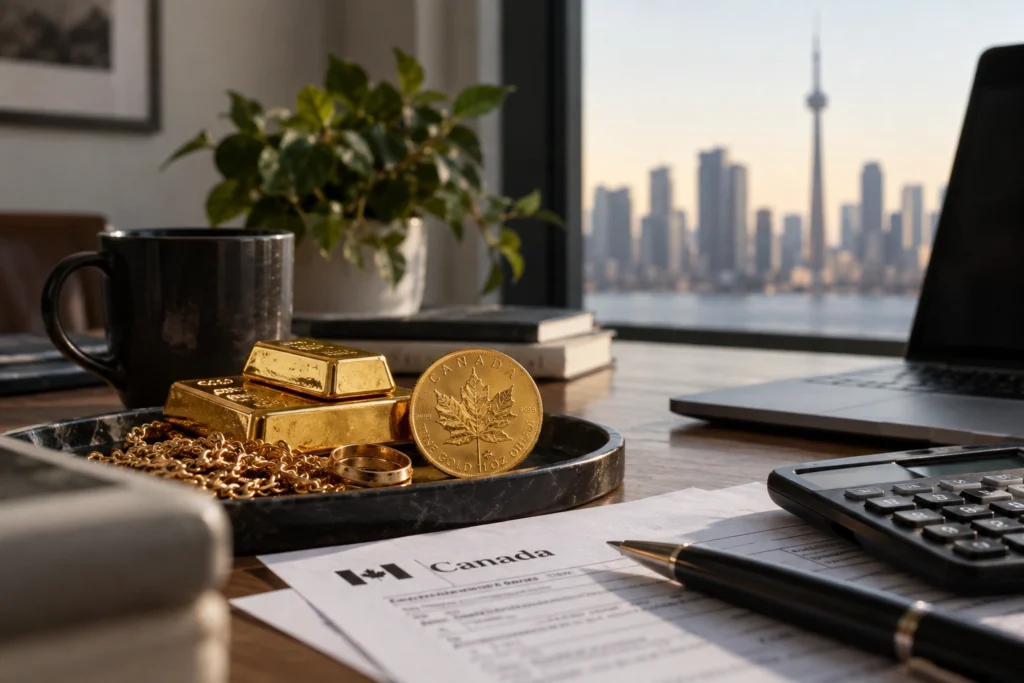
Gold has been valued as a safe place to put your money. Whether you are buying a Gold Maple Leaf coin, a small bar, or a piece of jewellery, you may wonder what happens when tax time comes around. Does the government take a cut? Do you pay tax on gold in Canada? The answer is not a simple yes or no. It depends on what you buy, why you buy it, and how you sell it.
This guide explains the tax rules for gold in Canada in plain, simple language. You will learn when taxes apply, when you do not have to pay them, and how to report your gold sales to the Canada Revenue Agency (CRA).
The article will also talk about the difference between gold you buy to invest in and gold you buy as a collectible. You’ll learn what happens tax-wise if you sell for a profit or at a loss and why keeping good records is important so you don’t run into problems later.
Key Takeaways
- Pure gold bullion (99.5% or higher) is usually free from GST/HST when you buy it.
- Selling gold at a profit counts as a capital gain. Only half of that profit gets added to your taxable income.
- Jewellery and lower-purity gold do not get the same tax break. They are taxed differently.
- Gold inside a TFSA or RRSP can grow without taxes getting in the way. But the rules are strict, and not all gold qualifies.
- Keep your receipts. You need them to prove what you paid and to figure out your gain or loss when you sell.
Do You Have to Pay Tax on Gold in Canada?
Thinking of buying or selling gold in Canada? Before you do, you need to know one thing: tax may or may not apply. It all depends on a few key factors, and knowing them could save you a bundle.
Here’s what really matters:
- What you bought: Pure bullion and investment coins like the Gold Maple Leaf get favourable tax treatment. Jewellery or rare collectibles? Not so much.
- Why you bought it: Was it a long-term investment? A gift? Part of your business? The CRA treats each one differently, and the difference can cost you.
- Where you park it: Gold tucked away in a TFSA or RRSP grows tax-free or tax-deferred. Gold under your mattress? That’s fully exposed come tax time.
There are clear CRA rules for separating investment gold from jewellery and collectibles. Understanding the rules and regulatory terms helps you interpret the possible applicable tax on your precious assets.
How Does Capital Gains Tax Apply to Gold?
Selling gold for more than you paid? That profit is what the CRA calls a capital gain, and the good news is, it’s treated favourably.
Here’s why that matters:
- Gold bullion and most investment-grade coins are classified as capital property, not business income. That means your profit is taxed at a much lighter rate than your regular salary or business earnings.
- Canada’s 50% inclusion rule works in your favour. Only half of your capital gain is taxable. For example, if you pocket a $5,000 profit, only $2,500 gets added to your taxable income for the year.
- You pay tax only on that $2,500, at your usual marginal rate. The other $2,500? Completely tax-free, straight into your pocket.
This tax treatment is exactly why gold bullion and coins can be a smart, tax-efficient addition to your portfolio. You keep more of your gains, and the CRA takes a much smaller bite than it would from employment income or other investments.
When Can Selling Gold Create a Capital Gain?
A capital gain occurs when your selling price is higher than your adjusted cost base (ACB). Your ACB includes:
- The original purchase price
- Dealer premiums
- Shipping and insurance costs when you bought the gold
If you sell gold for less than your ACB, you incur a capital loss. You can use this loss to offset capital gains from other investments. However, it is also suggested to determine the value of your items using a reliable tool like Gold Calculator to prevent losses and ensure accurate measurements.
Is Gold Tax-Free in Canada?
Gold is not entirely tax-free in Canada. However, there are some important exemptions that can make it more tax-efficient.
Investment-Grade Gold Bullion
Investment-grade gold bullion (99.5% purity or higher) is exempt from GST/HST when you buy it. This includes:
- Gold Maple Leaf coins (99.99% pure)
- Gold bars from recognised refineries (e.g., Royal Canadian Mint, PAMP Suisse)
- Other government-minted bullion coins that meet the purity threshold
This exemption is a significant advantage because it means more of your money goes into the metal itself, not into taxes.
Gold Products That May Be Taxable
Not all gold products are treated equally. The following are generally not eligible for the GST/HST exemption:
| Product Type | Reason |
| 14K or 18K Gold Jewellery | Purity is below 99.5%. |
| 22K Gold Bangles | Purity is below 99.5%. |
| Collectible or Numismatic Coins | Sold for rarity, not metal value |
| Proof or Graded Coins | Considered collectibles, not bullion |
These items are taxed as standard retail purchases, meaning you pay full GST/HST when you buy them.
GST and HST on Gold Purchases in Canada
The GST/HST rules are straightforward for investment-grade gold.
- Gold bullion (≥99.5% pure) is zero-rated for GST/HST. This means no tax is charged at the time of purchase.
- Gold jewellery and lower-purity gold are taxable. You pay the full GST/HST rate applicable in your province.
- Gold coins that are legal tender and meet the purity standard are also exempt, provided they are not sold as collectibles.
This tax advantage makes bullion much more cost-effective than jewellery for investment purposes.
Do You Pay Tax When Selling Gold?
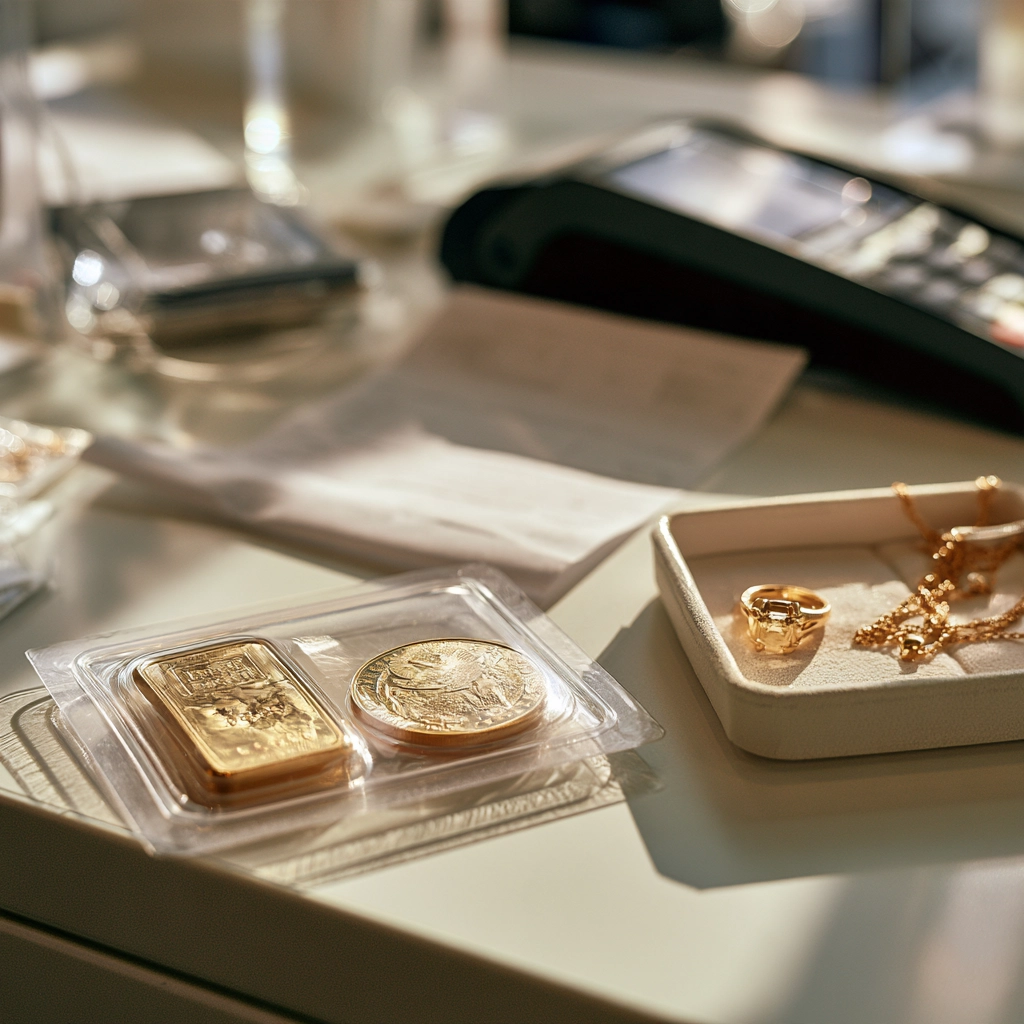
Yes, you typically pay tax on the profit when you sell gold. The rules depend on how the CRA views your activity.
| Situation | Tax Treatment |
| Holding gold as a long-term investment | 50% of the capital gain is taxable at your marginal rate. |
| Frequent buying and selling | The CRA may treat you as a business. Profits are 100% taxable as business income. |
| Selling jewellery for less than $1,000 | May not be taxable if the sale was not profitable. |
| Selling jewellery for more than $1,000 | May need to be reported, even if it was a personal item. |
If you are unsure about your status, consult a tax professional. The CRA looks at the frequency of trades, the nature of your transactions, and your overall intent.
How to Calculate a Capital Gain on Gold?
Calculating your capital gain is straightforward with good records.
Formula:
Capital Gain = Selling Price – (Purchase Price + Purchase Costs)
Example:
- You bought a 1 oz Gold Maple Leaf for $2,500 (including shipping).
- You sold it for $3,000.
- Your capital gain is $500.
Of this $500 gain, 50% ($250) is added to your taxable income for the year.
Example Gold Tax Calculation
Let’s take an example into account to understand the gold tax calculation.
| Detail | Example Amount |
| Original Purchase Price | $2500 |
| Purchase-Related Costs | $50 |
| Adjusted Cost Base (ACB) | $2550 |
| Selling Price | $3200 |
| Selling Expenses | $50 |
| Need Proceeds | $3150 |
| Capital Gain | $600 |
| Taxable Capital Gain | $300 |
In this example, $300 is added to your taxable income and taxed at your marginal rate.
Tax Rules for Gold Coins and Jewellery
Here are some general tax rules for gold coins and jewellery in Canada.
Gold Coins
- Bullion coins like Gold Maple Leafs are treated as investment gold. No GST/HST when you buy. When you sell at a profit, only half of that profit is taxable.
- Collectible coins are different. If you pay extra because a coin is rare, old, or has a special finish, it may not qualify as bullion. You might still get the capital gains treatment, but the GST/HST exemption may not apply when you buy.
- Same coin. Different tax rules. A coin that looks like bullion can be treated as a collectible if its value comes from rarity rather than gold content.
- So before you buy, check what you are actually getting. It could save you from a surprise at tax time.
Gold Jewellery
- Jewellery usually doesn’t fall under the category of investment gold. It is mostly 14k, 18k, or 22k, less than 99.5% pure. So it does not get the same tax treatment as bullion.
- When jewellery is bought, GST/HST is paid like any retail purchase. That tax adds to the cost upfront, making it less attractive if your goal is to invest.
- When you sell, the rules depend on whether it is a personal item or an investment piece. Selling an old necklace you wore is different from selling jewellery you bought to make a profit.
- If you sell a piece for more than $1,000 and make a profit, you may need to report it. Even personal items can trigger this.
- The bottom line: jewellery and investment gold are not the same. Do not assume the same tax rules apply.
Gold Held in a TFSA or RRSP
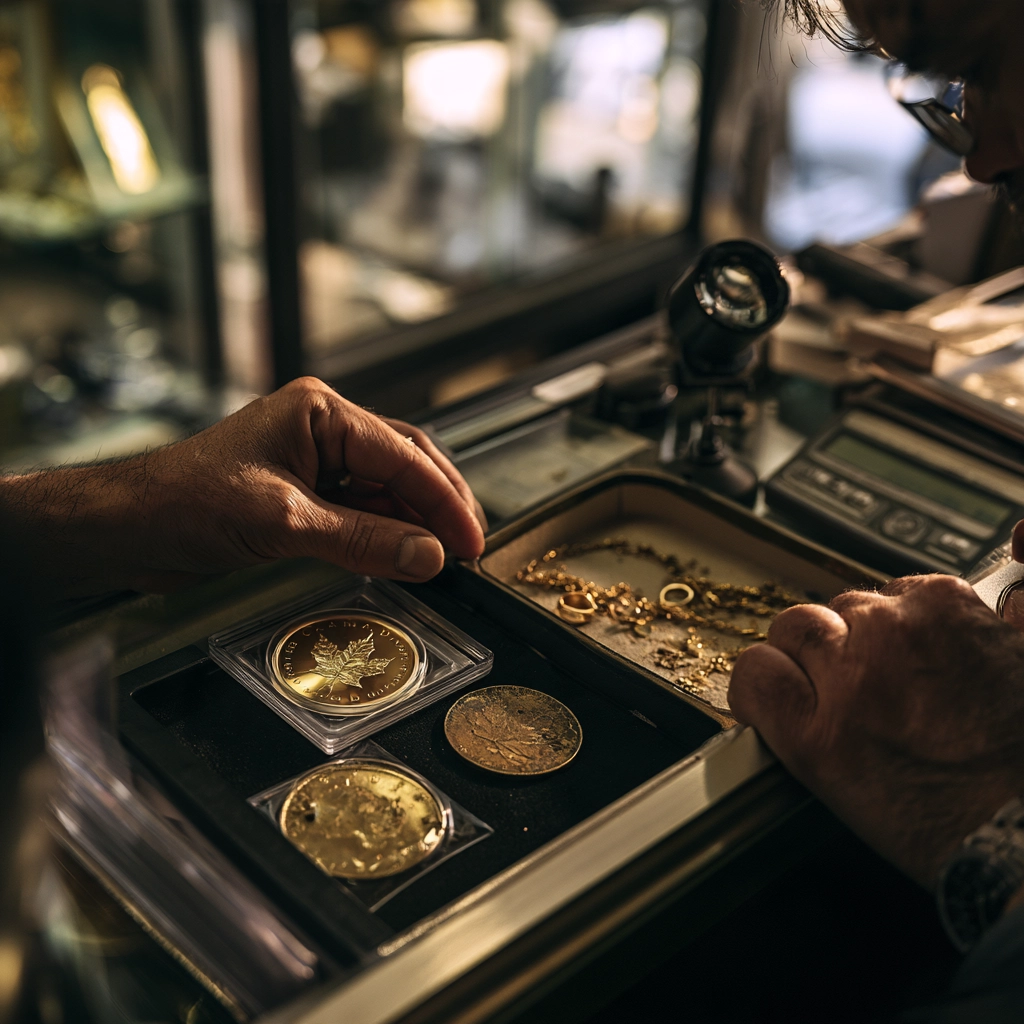
Certain gold investments can be held inside a TFSA or RRSP, but the rules are strict.
What qualifies:
- Gold bullion coins and bars that meet the 99.5% purity standard.
- Gold ETFs and mutual funds that hold physical gold.
What does NOT qualify:
- Jewellery
- Collectible coins
- Gold that you keep in your own possession
The custody rule: You cannot keep the gold at home. It must be held by the plan’s trustee at an approved third-party depository.
Tax advantage: Gold inside a TFSA grows tax-free. In an RRSP, growth is tax-deferred until withdrawal. This can be a powerful way to avoid capital gains tax on your gold investments.
How to Report Gold Profits to the CRA?
Reporting your gold sales correctly is important to avoid penalties.
Keep Records of Your Gold Purchases
Save all receipts, invoices, and shipping documents. These establish your adjusted cost base (ACB), what you paid for the gold. Without proper records, the CRA may not accept your claimed cost, and you could end up paying tax on the full sale price.
Track Selling Fees and Other Costs
Record dealer commissions, shipping, and insurance costs when you sell. These expenses reduce your net proceeds, which lowers your taxable gain. The more costs you track, the less tax you’ll owe.
Report the Sale on the Correct Tax Form
Capital gains from gold are reported on Schedule 3 (Capital Gains and Losses) of your personal tax return. This is where you calculate your gain or loss based on your proceeds, ACB, and selling expenses.
Watch for Foreign Reporting Requirements
If you held gold outside Canada and its total value exceeded $100,000 CAD at any point during the year, you must also file Form T1135 (Foreign Income Verification Statement). Missing this can trigger significant penalties.
Know the Business Income Risk
If the CRA determines that your gold buying and selling activity is a business, not a personal investment, your profits are treated as business income. That means 100% is taxable, not just the usual 50% for capital gains. Frequent traders and flippers are especially at risk.
Common Mistakes to Avoid
- Assuming all gold is tax-free: Only pure gold bullion (99.5% or higher) gets the tax break. Jewellery and collectibles do not qualify.
- Losing your receipts: Without proof of what you paid, the CRA may tax you on the full selling price. Keep every receipt safe.
- Not reporting a profit: Any gain must be reported, no matter how small. Ignoring it can lead to penalties.
- Forgetting gold stored outside Canada: If your foreign gold is worth over $100,000 CAD at any time, you must file Form T1135. Many people miss this.
- Mixing jewellery with investment gold: Jewellery is taxed differently from bullion. Keep them separate in your records.
- Not tracking selling costs: Dealer fees, shipping, and insurance reduce your profit. Track them so you do not overpay tax.
- Buying collectible coins without knowing the rules: A coin may look like bullion but be treated as a collectible if it is rare or has a special finish. That changes the tax treatment.
Quick Checklist Before Selling Gold
| Task | Completed |
| I have purchase receipts to prove my cost. | |
| I have calculated the adjusted cost base (ACB). | |
| I have recognised whether the withheld gold is bullion or a collectible. | |
| I am clear about whom to sell to, e.g., an investor or as a business. | |
| I have interpreted about will sale create a capital gain or a capital loss. | |
| I have to keep records of selling expenses. | |
| I have found out whether I need to report foreign-held gold on Form T1135 or not. |
Final Thoughts
So, do you pay tax on gold in Canada? It really comes down to what you buy, why you hold it, and how you sell it. If you go with investment-grade bullion like Gold Maple Leafs, you skip GST/HST when you buy.
And when you sell at a profit, only half of that profit gets taxed. That makes bullion a smart, tax-friendly choice for long-term investors.
Gold inside a TFSA or RRSP can grow without taxes eating into your returns. But the rules are strict. You cannot keep the gold yourself, and only certain types qualify.
If your goal is to invest, bullion is usually the better route. Jewellery and collectibles come with different rules and fewer tax breaks.
FAQs
Do I pay tax if I sell gold for the same price I paid?
No. If you sell gold for the same price you paid (or less), there is no capital gain to report. However, you should still keep records to prove that there was no gain.
Can I claim a loss after selling gold?
Yes. If you sell gold for less than your adjusted cost base, you incur a capital loss. You can use this loss to offset capital gains from other investments.
Do I need receipts when reporting a gold sale?
Yes. You need receipts to prove your purchase price and selling expenses. The CRA may request these documents during an audit.
Is inherited gold taxable when I sell it?
The inheritance itself is not taxed. However, when you sell the inherited gold, the capital gain is calculated based on the fair market value at the time you inherited it, not what the original owner paid.
Are collectible gold coins taxed differently from bullion?
Yes. Collectible coins may not qualify for the GST/HST exemption. When sold, they may also be subject to different capital gains rules if they are considered personal-use property.
Does a gold dealer report my sale to the CRA?
Dealers do not report every sale to the CRA automatically. But they do keep records. They may also report large cash transactions or anything that looks suspicious. Either way, you are still responsible for reporting your own capital gains. The CRA expects you to be honest about your profits.